
Early Detection of Neurological Disorders through Computerized Analysis of Handwriting – An Application to Parkinson’s Disease
This project is aimed at early prediction of Parkinson’s disease through computerized analysis of online handwriting samples. While a number of clinical evaluations are carried out to diagnose the Parkinson’s disease, most of these tests are effective only once the disease is at a relatively advanced stage. Studies have shown that analysis of handwriting can be used as a valuable tool for prediction of Parkinson’s disease at very early stages. In the proposed research, we have employed raw signals captured by a digitizer tablet while attempting several writing and drawing templates, to compute various kinematic, temporal, and pen-based attributes. In addition to these online dynamic attributes, static offline visual features are also extracted using state-of-the-art Convolutional Neural Networks (CNNs). The developed tools allow practitioners to collect handwriting and drawing samples of subjects and employ a combination of different types of features (online and offline) for the analysis and prediction.

This project is aimed at early prediction of Parkinson’s disease through computerized analysis of online handwriting samples. While a number of clinical evaluations are carried out to diagnose the Parkinson’s disease, most of these tests are effective only once the disease is at a relatively advanced stage. Studies have shown that analysis of handwriting can be used as a valuable tool for prediction of Parkinson’s disease at very early stages. In the proposed research, we have employed raw signals captured by a digitizer tablet while attempting several writing and drawing templates, to compute various kinematic, temporal, and pen-based attributes. In addition to these online dynamic attributes, static offline visual features are also extracted using state-of-the-art Convolutional Neural Networks (CNNs). The developed tools allow practitioners to collect handwriting and drawing samples of subjects and employ a combination of different types of features (online and offline) for the analysis and prediction.
Funding Body: HEC-NRPU
Project Team
- Dr. Imran Siddiqi – Principal Investigator
- Dr. Uzma Masroor – Co-Principal Investigator
- Dr. Momina Moetesum
- Saman Khawar
- Farah Javed
Publications
- Moetesum, M., Diaz, M., Masroor, U., Siddiqi, I., & Vessio, G. (2022). A survey of visual and procedural handwriting analysis for neuropsychological assessment. Neural Computing and Applications, 1-18.
- Diaz, M., Moetesum, M., Siddiqi, I., & Vessio, G. (2021). Sequence-based dynamic handwriting analysis for Parkinson’s disease detection with one-dimensional convolutions and BiGRUs. Expert Systems with Applications, 168, 114405.
- Moetesum, M., Siddiqi, I., Javed, F., & Masroor, U. (2020, September). Dynamic Handwriting Analysis for Parkinson’s Disease Identification using C-BiGRU Model. In 2020 17th International Conference on Frontiers in Handwriting Recognition (ICFHR) (pp. 115-120). IEEE.
Project Demo
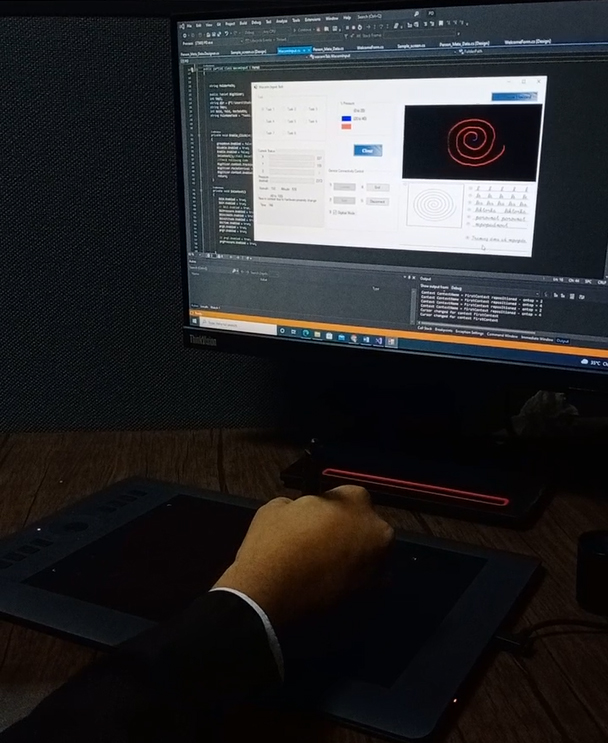
Data Acquisition using Wacom Digitizing Tablet